Research
Current Research Interests
Reactive intermediates in combustion, interstellar chemistry, chemical synthesis, and biochemistry; investigated by laser spectroscopy and spectroscopic theory, and by computational quantum mechanics.
Our work focuses on reactive intermediates, especially in combustion and interstellar chemistry, as investigated by laser spectroscopy and computational quantum mechanics. Collaborative work has included studies of spectroscopic theory, chemical catalysis, and organometallic photophysics.
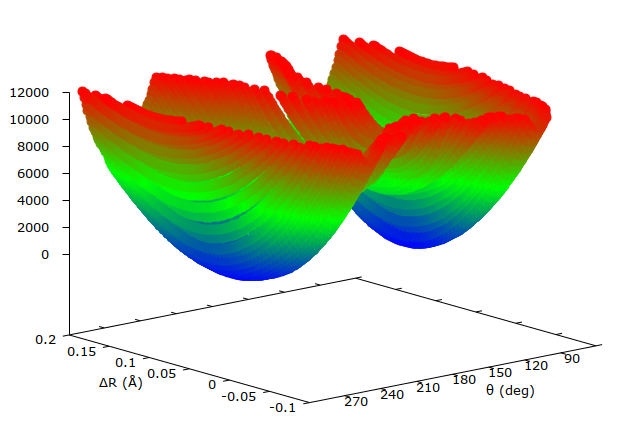
Molecular free radicals and ions are crucial to the chemistry of combustion, the upper atmosphere, polymerization, and interstellar molecular clouds. We are interested in the physical and chemical properties of these molecules, particularly those containing conjugated π-electron systems, such as HC3O and HCCO-, because the delocalized orbitals can confer surprising vibrational dynamics and reactive properties to these systems. Specifically, we investigate a phenomenon we call relocalization, in which unpaired or lone pair electrons can exchange localization with π electrons to change the hybridization of an atom, leading to relatively low energy interconversion between geometries that correspond to distinct Lewis structures: too distinct to be considered resonance structures, but separated by little or no barrier so as to rapidly interconvert at low temperatures.
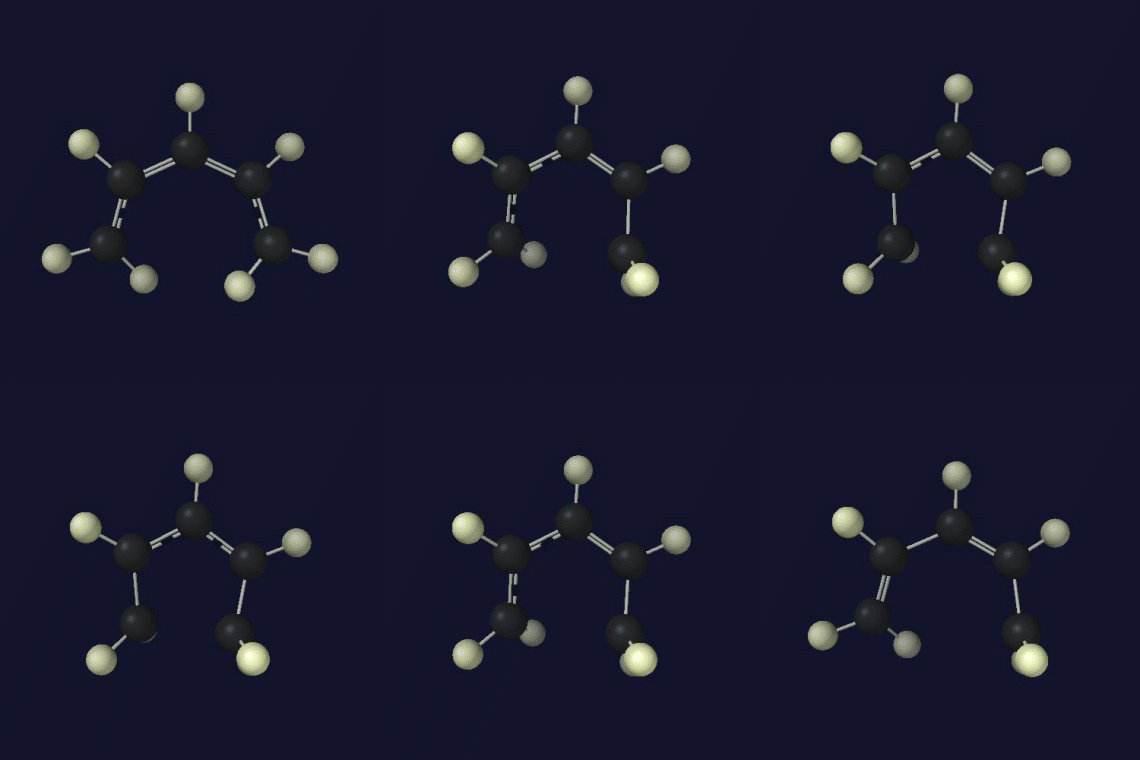
Computational Studies of Free Radical Structures and Dynamics
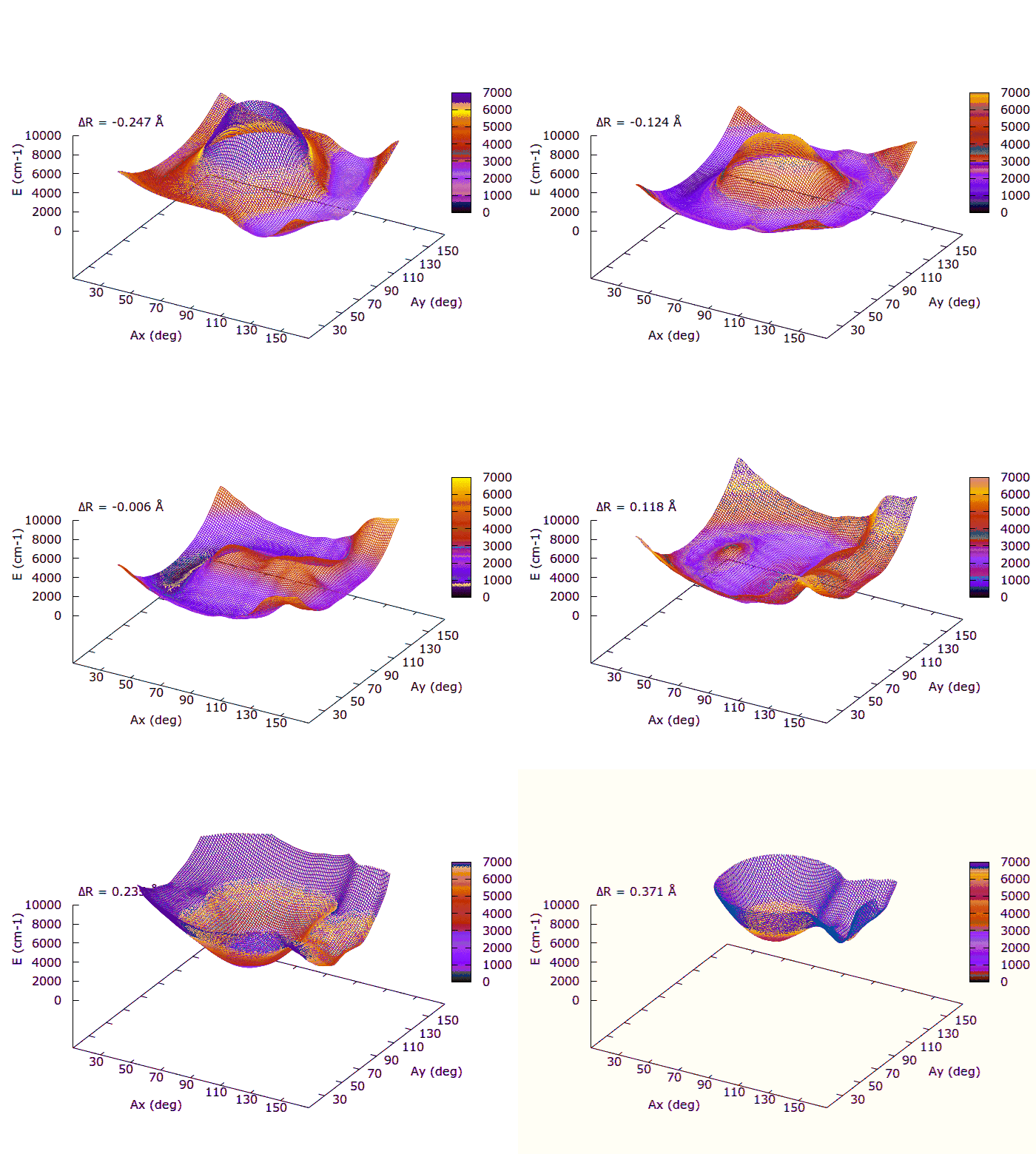
Recognizing the need for a general, easily mastered way to study these complex vibrational dynamics, our group developed and maintains the software package FEMvib for solving the vibrational Schrödinger equation on an arbitrary potential energy surface (PES) of 2 or 3 dimensions, using the finite element method. Our approach requires the user to provide a pointwise PES (energies and geometries), from which it interpolates a fine grid of points and integrates the Schrödinger equation, providing the solution eigenstates and eigenvalues.
Previous work in our group along these lines included studies of the mechanisms behind the elctrocyclic ring-closure of cyclopentadienyl radical (C5H5) and the vibrational dynamics of cyclooctatetraenyl (C8H7), including its effective isomerization from one structure to another under specific vibrational excitations.
High Resolution Spectroscopy of Free Radicals
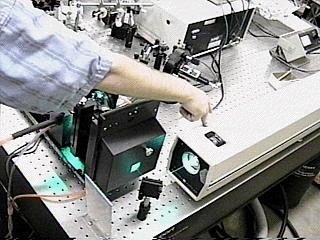
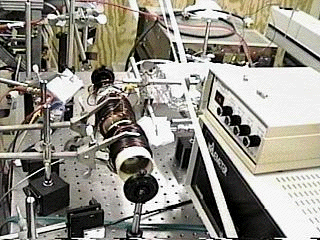
In our experimental work, we search for new spectra of small hydrocarbon or related free radicals in the infrared regions of the spectrum in order to characterize these dynamic properties. A Daylight tunable mid-infrared quantum cascade laser is our radiation source, and reactive molecules are generated using a 1 kV glow dischage through a 2-meter 20-pass White cell. With this system we search for strong stretching transitions in the reactive molecules. We then probe the isomerization coordinate by examining hot band and combination band spectra to obtain measurements at high resolution of the unusual vibrational dynamics associated with relocalization. This work has been funded by the NSF (including one of the first NSF CAREER awards), the Army Research Office, Exxon, and the Petroleum Research Fund.
Photophysics of Nucleobases and Organometallics
We have been collaborating with Prof. Byron Purse to better understand the physics of high-quantum-yield nucleobase analogs developed in his laboratory. In addition, we have been contributing to several studies by Prof. Hani Amouri of the CNRS (Centre National de la Recherche Scientifique) in Paris. Prof. Amouri assembles organometallic complexes, often with two or more metal atoms, in a search for novel optoelectronic materials and nanostructures. Our work has supported the interpretation of spectroscopic and x-ray data by modeling characteristics of the molecular orbitals and intramolecular interactions.
Software
Chem_rate_fit, v1.0.0 2024. Fortran code for least-squares fits of rate coefficients, initial concentrations, and initial times to chemical kinetic data.
FEMvib, v2.2.00 2024. A combination of C++ code and Python scripts designed to solve the vibrational Schrodinger equation based on an input pointwise potential energy surface of 2 or 3 dimensions. The molecular geometries at each point are converted to pointwise dynamic G matrix elements to obtain the kinetic energy term. A Kriging interpolation scheme is then used to generate a fine grid for numerical integration using the finite element method as implemented by LibMesh library routines.
Acknowledgements
We gratefully acknowledge funding for past and current work from the Army Research Office, the National Science Foundation, the Petroleum Research Fund of the American Chemical Society, the Exxon Education Foundation, and the San Diego Foundation.